+1 416 895 3026
 Fee Calculator




















Updated: September 14, 2026
If you are an experienced business owner or manager, Canada wants you here. Business immigration gives you a real, structured path to move your life and your business to Canada – and eventually to call yourself a Canadian citizen. It is not a single program or a single step. It is a journey, and this page walks you through the whole thing.
You do not need to be a Canadian resident to get started, and you do not need to have the money already invested. What you do need is a credible business idea, enough capital to back it up, and a genuine intention to run the business here. Canada’s entrepreneur programs are built for people in that exact position.
This guide takes you from the very first step — your work permit application — all the way through to permanent residence and citizenship. Most people reach permanent residence within 2 to 2.5 years of starting the process.
Key Takeaways
- The path to permanent residence through business ownership takes roughly 2–2.5 years.
- You start with an Entrepreneur Work Permit (based on your business plan — no upfront investment required at this stage).
- You should budget at least $200,000 CAD for your business ($250,000 if buying an existing business).
What Is Business Immigration to Canada?
Business immigration in Canada is a category of immigration built around what you do as a business owner – not just where you worked or what degree you earned. These programs are designed for people who want to bring a business to Canada, create jobs, and build something real here. If that describes you, you are in the right place.
What makes these programs different from other immigration routes is the opportunity they give you before you commit. You can come to Canada on a work permit, test your business idea in the real market, see if the community and province feel right for your family, and make adjustments – all before anything becomes permanent. Once you are confident, you move forward to permanent residence.
That is the path this guide focuses on, and the one that works for most of our clients: come first, test, then commit. By the end of the process, you will have permanent residence for yourself and your family.
Can I Start a Business in Canada Without PR?
Yes – you can register a Canadian business without being a permanent resident or citizen. The catch is that you cannot actually work in that business without a valid work permit. That means no managing operations, making decisions, or showing up day-to-day until your permit is in hand. In the meantime, you would need a Canadian resident to run things on your behalf.
A lot of clients ask us: Should we invest in the business first and worry about the permit later? We always say the same thing: do it the other way around. Your work permit is based on your business plan, not how much money you have already spent. Get the permit approved first, then commit your capital once you are legally authorized to work in Canada.

How to Get Canadian Permanent Residence Through Business Ownership
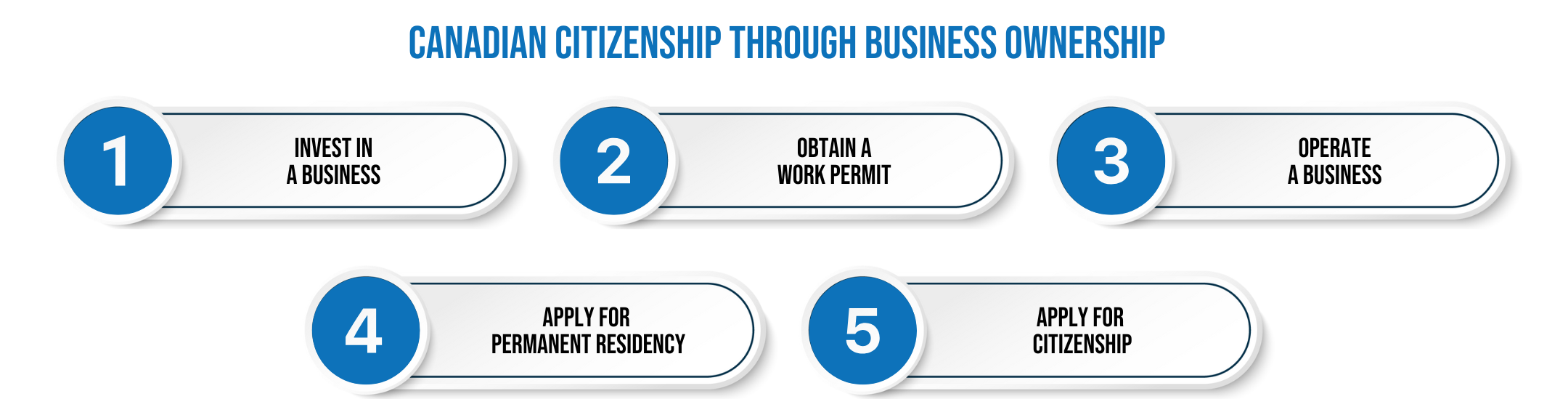
The process moves through three phases, and each one builds naturally on the one before it. Together, they typically take 2 to 2.5 years to reach permanent residence. Here is how it all works.
Phase 1: Entrepreneur Work Permit
This is your starting point. Before you invest a single dollar, you submit a work permit application based on your business plans. If it is approved, you and your family can come to Canada, get settled, and begin building.
Step 1: Develop Your Business Concept
You start by putting together a business concept – either by proposing something new you want to launch, or an existing business you want to buy. You do not need to have spent any money yet. What matters at this stage is showing that your plan is realistic and that you have the funds available to carry it out.
On average, you should have at least $200,000 CAD in liquid funds. If you are buying an existing business, set a starting budget of $250,000 — the extra $50,000 covers closing costs like broker fees, legal work, and accountant fees, which add up faster than most buyers expect.
Step 2: Register, Plan, and Apply
Once your concept is ready, you register the business in your chosen province, put together your business plan, and submit your work permit application. The application is reviewed based on the strength of your plan, your relevant background, and the economic benefit your business will bring to Canada. This type of work permit is issued to people whose business activity creates a meaningful benefit for the country.

What You Get If Approved
Most decisions come back within 3 to 4 months. If your application is approved, here is what your family receives:
- A 2-year Entrepreneur Work Permit for you
- An Open Work Permit for your spouse — they can work with you or for any employer in Canada
- Status for your children under 22 — a study permit or visitor status, depending on their age
Why This Phase Matters
This phase is intentionally low-risk. Your whole family gets access to provincial health care, and post-secondary children may qualify for domestic tuition rates. More importantly, you can arrive in Canada, test your market, and see whether the community you have chosen actually feels right for your family – all before you sign anything binding with a province. If something needs to change, this is the time to change it.
Phase 2: Provincial Endorsement
Once you arrive, we give you 2 to 3 months to settle in properly – explore the community you’ve chosen, test your market, and make sure it’s the right fit. You can still make changes during this window, whether that means adjusting your business model or reconsidering your location. Once you are confident and ready to move forward, we start the permanent residence application together.
Step 1: Confirm Your Business and Start the Application
When you are ready, we pitch your business to the province for their review and endorsement. At this point, you will need a few key documents to move things forward.
What you will need:
- Approved language test results
- An Education Credential Assessment (ECA) — The World Education Service is the most commonly used provider
- A business plan the province can review
- A net worth verification report from a province-approved verifier
- A record of your business experience
Step 2: The Province Reviews Your Application
The province goes through your business plan carefully, verifies your net worth, and assesses whether your business is a good fit for their community. This is a genuine evaluation – they are deciding whether to put their name behind your permanent residence application, so they take it seriously.
Step 3: Sign the Provincial Contract
If the province wants to work with you, they will send over a contract outlining what your commitments will be. Once you sign it, they give you their endorsement, and the timeline to meet your commitments starts.
Important: Once you sign the contract, you are committed. The terms are binding. You need to follow through on your business plan to get your PR. Plan to be physically present and running your business at least 75–80% of the time.
Phase 3: Commitment Period and PR Application
With the province’s endorsement in hand, your commitment period begins. This is typically 12 months – though it can be as short as 6 months in Manitoba or New Brunswick. During this time, you show the province that you have followed through on what you agreed to do. For most of our clients, it is the most demanding part of the process, and also the most rewarding.
Step 1: Run Your Business and Meet Your Commitments
During this period, you are expected to:
- Hire at least one qualifying Canadian employee
- Put your required investment into the business
- Be physically present and actively running the business — at least 75–80% of your time, in the province
Step 2: The Province Confirms Your Results and Endorses You
At the end of the commitment period, the province reviews what you have done against what you committed to. If you have met your obligations, they give you their PR Endorsement – the official green light for your permanent residence application.
Step 3: Apply for Permanent Residence
With your endorsement from the province, you can now submit your permanent residence application, together with your spouse and kids. PR decisions usually take 6 to 8 months from submission. By the time everything is done, most people have been in the process for about 2 to 2.5 years from when they first applied for their work permit.
Choosing Your Province: Where Should You Set Up Your Business?
Seven provinces have active entrepreneur immigration programs. Each one has its own industries, investment thresholds, and lifestyle. The table below gives you a quick comparison so you can start thinking about where your business fits best.
| Province | Key Industries | Major Cities | GDP/Outlook | Notable Information |
|---|---|---|---|---|
| British Columbia | Technology, film, natural resources, tourism | Vancouver, Victoria, Kelowna | ~$400B; growing tech hub | High cost of living; strong Asia-Pacific ties |
| Alberta | Energy, agri-business, technology, logistics | Calgary, Edmonton, Red Deer | ~$440B; diversifying post-oil | No provincial sales tax; business-friendly |
| Manitoba | Agri-food, manufacturing, aerospace, health | Winnipeg, Brandon, Steinbach | ~$85B; steady growth | Low operating costs; shorter commitment period (6 months possible) |
| Nova Scotia | Ocean technology, fisheries, tourism, clean energy | Halifax, Dartmouth | ~$50B; growing startup scene | Atlantic immigration advantage; lower costs |
| New Brunswick | Forestry, agri-food, IT, call centres | Moncton, Fredericton, Saint John | ~$40B; expanding technology sector | Low business costs; bilingual workforce; 6-month performance period |
| Newfoundland & Labrador | Offshore energy, fisheries, tourism, mining | St. John's, Corner Brook | ~$35B; energy-driven recovery | Low competition; strong government support for new businesses |
| Ontario | Finance, advanced manufacturing, technology, life sciences | Toronto, Ottawa, Hamilton, Kitchener-Waterloo | ~$950B; Canada's largest economy | Largest consumer market; high cost of living; high operating costs |
The province you pick matters. Choose somewhere your type of business makes sense, where your family can see themselves living, and where the cost of doing business works for you. Immigration becomes a lot easier when the business decision is the right one.

How to Get Canadian Citizenship as a Business Owner
Citizenship is the final chapter. Once you have your permanent residence, the clock starts on the time you need to spend in Canada before you can apply. Here is what that looks like.
Step 1: Build Your Business and Get Your PR
Everything starts with the three phases above. You get your work permit, run your business in Canada, meet your provincial commitments, and receive permanent residence. That journey typically takes about 2 to 2.5 years.
Step 2: Meet the Residency Requirement and Apply for Citizenship
To apply for Canadian citizenship, you need to have been physically present in Canada for at least 1,095 days – three years – out of the five years before you apply. The time you spent here on a work permit before receiving your PR counts toward that total, but at half the rate. One day on a work permit equals half a day of credit, up to a maximum of 365 days.
Along with the residency requirement, you will need to pass a language test in English or French, pass a citizenship knowledge test covering Canadian history, government, and values, and show that you have filed your Canadian taxes. If you are between 18 and 54 at the time of your application, both the language and knowledge tests apply to you. Your children can be included in the same application.
How Can I Invest in a Canadian Business?
There are four ways to get into a Canadian business as a foreign owner. Each one has different costs, risks, and immigration requirements. Here is a quick breakdown.
| Business Model | Cost | Risk Level | Notes | Best For |
|---|---|---|---|---|
| Start A New Business | Moderate: $150,000+ | Higher | Full control of business direction; building a business from the ground up | Entrepreneurs with a clear concept and confidence to build in a new market |
| Buy A Business | High: $250,000+ | Moderate | Immediate operations; due diligence critical; plan for closing costs | Buyers who want an existing customer base and to focus on growing and running a business instead of starting one |
| Buy Shares in a Business | High: $200,000-$500,000 | Moderate | Business must be active; you need sufficient ownership to demonstrate management control; partner must be a Canadian citizen or PR | Maintain a greater level of creative control and direction; benefit from the institutional knowledge of an experienced business partner |
| Buy a Franchise | Moderate $150,000+ | Moderate | Proven system; franchise agreement adds complexity; 12 months usually required for new locations | Least amount of control, but comes with pre-established and proven systems, networks and support |
You do not need to invest your money before your work permit is approved. Your permit application is based on your business plan. That said, you will need to show that the funds are ready and accessible – not locked up in property or long-term accounts – and that you have a genuine intention to run the business. This includes a clear and well-developed business plan. If you are buying a business, shares or a franchise, you need to show that you have made real steps to come to an agreement with the seller, business owner, or franchisor.

Frequently Asked Questions About Business Immigration in Canada
Below, you will find answers to the most commonly asked questions related to the subject at hand.
In general, developing a strong business idea is crucial for potential immigrants, as it forms the foundation of successful immigration for business owners and is often a common question among those considering this pathway. To learn more about the main pitfalls of a business plan, watch this video.
How much money do I need to apply for an Entrepreneur Work Permit?
You should budget at least $200,000 CAD in liquid funds for a new business to help you offset and cover all your operating costs. If you are buying an existing business, plan for a starting budget of $250,000, with some of this specifically set aside to cover closing costs. Remember, the money needs to be accessible – cash or near-cash.
Can I buy an existing Canadian business to qualify for business immigration, rather than starting one from scratch?
Yes, and for many international entrepreneurs, acquiring an existing Canadian business is a faster and lower-risk entry point than building one from the ground up. Purchasing an established business gives you an immediate operational footprint: existing customers, revenue history, employees, and premises. That said, the acquisition must be genuine and arms-length. Officers will look closely at the purchase price relative to market value, your ownership stake, whether the previous owner has been appropriately transitioned out of day-to-day management, and whether you are genuinely running the business or simply holding shares. A business acquisition that looks like a convenience arrangement, where the original owner continues to operate and you play no active role, will not satisfy immigration requirements. Done properly, however, buying a Canadian business is a well-established and legally sound pathway to permanent residence. Our lawyers advise on business acquisition due diligence, purchase structure, and immigration strategy as a combined service.
Can I bring my family with me?
Yes. Your spouse gets an Open Work Permit, which allows them to work with you in the business or find employment in Canada. Children under 22 get either a study permit or visitor status, depending on their age. Your whole family is also included in your PR application.
What happens if I don’t meet the terms of my Commitment Agreement?
If you miss the targets in your Commitment Agreement – such as the hiring or investment requirements – the province will not endorse you for PR. This is why it is important to be prepared and feel confident before starting your PR journey.
What language level do I need?
Most provinces require a Canadian Language Benchmark (CLB) level of 4 or 5 in English or French. That is a basic working level – you do not need to be fluent. You will need to take a formal test like IELTS (English) or TEF Canada (French) and present the results to the province.
What types of businesses are not allowed?
You should avoid passive businesses – things like holding companies or rental properties where you are not actively working or which won’t create meaningful benefits for the community. Home-based businesses and some regulated industries should also be avoided. Your business needs to create real jobs and real economic activity. If you’re not sure whether your business is a good fit, we can help you assess!
Do I need to invest the money before my work permit is approved?
No. Your work permit is based on your business plan, your experience and your available funds, not your actual investment. You can come to Canada, test the market, and get comfortable before spending a dollar. The investment happens during the performance period, after you have signed the provincial agreement.
How long does the whole process take?
Plan for 2 to 2.5 years from work permit application to PR. Work permit decisions take 3 to 4 months. After arriving, you have a few months to settle before starting the PR process. The commitment period is typically 12 months — 6 months in Manitoba and New Brunswick. Then 6 to 8 months for the federal PR decision.
How Sobirovs Law Firm Can Help
Business immigration is all we do at Sobirovs Law Firm. We work with business owners at every step – from picking the right province and putting together your business plan, to getting your work permit, managing the provincial endorsement process, and seeing your PR through to the end.
- We help you identify the best business opportunity and structure your entry strategy before you commit any capital.
- We prepare and submit your Entrepreneur Work Permit application, including your business plan and supporting documentation.
- We manage your provincial endorsement application — coordinating the net worth verification, business plan review, and, if required, the provincial interview.
- We submit your PR application and handle all correspondence with IRCC on your behalf.
Ready to take the first step?

Tools and Resources
Eligibility and Assessment Tools
Official Government Resources
- Approved Language Testing Providers
- Approved Education Credential Assessment Organizations
- Citizenship Requirements
About Sobirovs Law Firm
Sobirovs Law Firm focuses exclusively on Canadian business immigration. We are a team of Licensed Immigration Lawyers and Consultants who help entrepreneurs, investors, and business owners navigate provincial and federal business immigration pathways. Our team combines legal expertise with practical business understanding to turn complex situations into successful outcomes. Learn more at sobirovs.com.