+1 416 895 3026
 Fee Calculator























Can you buy Canadian citizenship in 2026?
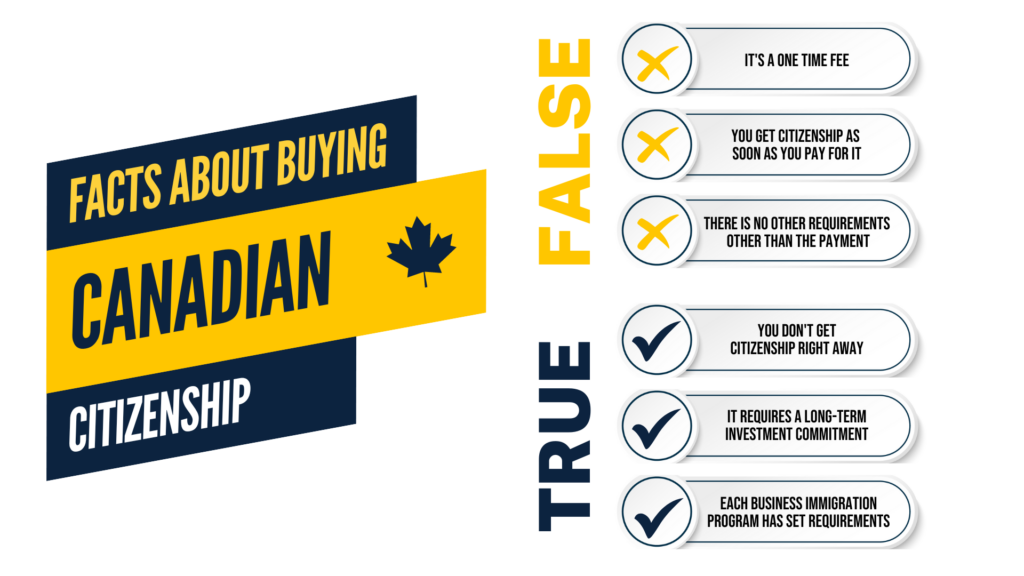
No. You cannot buy Canadian citizenship, and no Canadian passport is for sale at any price. Canada has never run a citizenship-by-investment program and does not offer one in 2026. What it does offer is permanent residence through owning and actively running a Canadian business — which can lead to citizenship years later, on the same terms as everyone else. This page explains every realistic pathway, what each one actually costs in 2026, and which candidates tend to succeed. We will also explain how you can obtain Canadian citizenship through business immigration and determine whether you are an ideal candidate for this path.
Under Canadian immigration law, you cannot buy a Canadian passport or Canada citizenship. The closest legal pathway is Canadian business immigration: you operate a business in Canada under a work permit, qualify for permanent residency within 1–2 years, and then become eligible for Canadian citizenship after 1,095 days of physical presence in Canada over any five-year period. Canadian immigration authorities assess active involvement in the business, legally acquired net assets, and the business’s contribution to the Canadian economy — not just the size of the cheque.
Essentially, under these investment immigration programs, you:
-
Operate your business in Canada under a work permit (C11, ICT, or PNP-nominated work permit).
-
Apply for and obtain Canadian permanent residence within 1–2 years of running your Canadian business.
-
Become eligible for Canadian citizenship after holding permanent residence and being physically present in Canada for at least 1,095 days (three years) in any five-year period.
Important 2026 update: the Canada SUV program, which was widely advertised as “passive investment” way of getting PR in Canada, has been paused for new applicants as of January 1, 2026. IRCC is no longer accepting new commitment certificates from designated organizations — including venture capital funds, angel investor groups, and business incubators — and a replacement entrepreneur pilot is expected in 2026. Applicants who received a valid 2025 commitment certificate must file their permanent residence application by June 30, 2026. For now, the active investment immigration routes to Canadian permanent residence are the C11 Entrepreneur Work Permit, Intra-Company Transfer, Provincial Nominee Program Entrepreneur streams, and the Quebec programs.
Canada does not operate a citizenship by investment program like Cyprus, Malta, or the Caribbean ‘golden visa’ nations. When international clients ask us how to buy Canadian citizenship, what they almost always want is the business immigration route to a Canadian passport: invest in a Canadian business, run it, earn permanent residence, and — after meeting the physical presence requirement — apply for citizenship.
What does work: investment routes to permanent residence
If what you actually want is to build a life in Canada with capital behind you, the question isn’t whether citizenship can be bought. It’s which residence program fits your money, your sector and the province you want to live in.
Those programs are real, and they run in the order the law requires: permanent residence first, roughly two years of business operation to get there, then about three more years of living in Canada before you can apply for citizenship. Slower than a golden passport. Also the only version that exists.
→ Canada investor visa: what each route requires, costs and how long it takes
You can always learn about your immigration options and the immigration process by booking a 1-hour consultation with our lawyer by booking a 1-hour consultation with our lawyers to find out exactly how you can obtain permanent residency and citizenship in Canada through business.
What is citizenship by investment — and why doesn’t Canada have one?
Citizenship by investment is a government program that grants citizenship — and a passport — to foreign nationals in exchange for a qualifying investment in the country’s economy. Classic citizenship by investment programs offer investment options like government bonds, government-managed real estate funds, or direct contributions to a development fund, usually in foreign currency. Popular examples include Malta, Saint Kitts and Nevis, Grenada, and Turkey. Canada is not one of them.
Canada’s position is different. Instead of selling citizenship, Canada runs a cluster of business immigration and investment programs that grant permanent residence to foreign entrepreneurs who invest in and actively run a business here. The required investment is real — it has to go into wages, premises, customers, and operations, not into a government bond or a passive fund (except the Quebec Immigrant Investor Program, which is a special case). After holding permanent residence and meeting the 1,095-day physical presence test, applicants become eligible to apply for Canada citizenship.
The real alternatives: business immigration programs that lead to Canadian residence
The closest legal route is to immigrate through one of Canada’s investment immigration programs. Each of these programs is open to foreign entrepreneurs and investor immigrants and leads — when run properly — to Canadian permanent residence, and eventually, Canadian citizenship. The applicant’s family (spouse or common-law partner and dependent children) can be included on the primary applicant’s file.

Who is eligible to apply for Canadian citizenship?
To become a Canadian citizen, an adult applicant must meet five core requirements set by Immigration Canada.
- First, be 18 years or older (adult children apply on their own file).
- Second, hold Canadian permanent resident status at the time of application.
- Third, have been physically present in Canada for at least 1,095 days during the five years immediately before the date of the application.
- Fourth, demonstrate language ability in English or French at roughly CLB/NCLC 4.
- Fifth, pass the citizenship test covering Canada’s history, values, symbols, and institutions, file any required Canadian tax returns, and have no serious criminal prohibitions. A clean criminal record, a valid passport, and up-to-date supporting documents are also required when you submit your application.
What are the language requirements for Canadian citizenship?
Applicants aged 18 to 54 at the time of application must prove they can communicate in English or French at Canadian Language Benchmark (CLB) 4, or Niveaux de compétence linguistique canadiens (NCLC) 4 for French, across speaking and listening. Acceptable evidence includes IELTS, CELPIP-General, TEF Canada, or TCF Canada results; a Canadian secondary or post-secondary credential completed in English or French; or certain government-funded language training certificates. Applicants 55 and older are exempt from the language evidence requirement. The citizenship test itself is administered in English or French, so practical fluency matters even beyond the formal CLB threshold.
The good news? You have multiple pathways to prove your language proficiency, each designed to recognize the diverse educational journeys that bring people to Canada. Most applicants choose proven testing routes like the IELTS (International English Language Testing System) for English or the TEF (Test d’évaluation de français) for French – reliable benchmarks that immigration officers trust. Already completed your education in English or French? That accomplishment likely serves as compelling evidence of your language abilities. This language requirement isn’t a barrier. It’s your gateway to successful integration and long-term prosperity in Canada, setting you up for the meaningful future you’re building here.
Quebec Immigrant Investor Program (QIIP) and Quebec Entrepreneur Program
The Quebec Immigrant Investor Program (QIIP) is Canada’s only passive investment visa. The Quebec Entrepreneur Program is the active counterpart — for applicants who want to start or acquire a real business in Quebec rather than sit on a passive investment.
How You Actually Become a Canadian Citizen: The Naturalization Route
There is one route to Canadian citizenship for someone who was not born a citizen and did not inherit it from a Canadian parent: become a permanent resident first, live here, and then apply for a grant of citizenship under section 5(1) of the Citizenship Act. No amount of investment shortens that route or replaces any part of it.
Here is what the law actually requires.
- You must already be a permanent resident. Citizenship is the step after PR, never instead of it. Your PR status must be valid, you must not be under a removal order, and you must have no unfulfilled conditions attached to your PR.
- You must have been physically in Canada for 1,095 days out of the previous 5 years. This is the requirement people underestimate most. It is 1,095 actual days — three full years — inside Canada during the five years immediately before you sign your application. Days you spent outside the country for work, family or travel do not count, whatever your intentions were.
- Time before you became a PR can count, but only at half rate. If you were in Canada legally as a worker, student or visitor — or as a protected person — before receiving PR, each of those days counts as half a day, up to a maximum credit of 365 days. This matters enormously to entrepreneurs, and we return to it below.
- You must have filed your Canadian taxes for at least 3 of those 5 years, where you were required to file under the Income Tax Act. Filing an entrepreneur’s personal return correctly while running a new Canadian corporation is a common failure point, and it is entirely avoidable.
- If you are between 18 and 54, you must show language ability and pass the citizenship test. The language standard is Canadian Language Benchmark 4 in English or French — enough to hold an everyday conversation and follow simple instructions. It is a functional threshold, not an academic one. The test covers Canada’s history, geography, economy, government, laws and symbols, along with the rights and responsibilities of citizens. Applicants 55 and over are exempt from both.
- If you are 14 or older, you take the Oath of Citizenship once your application is approved.
What this means for a business owner in practice
The half-day credit is the part worth planning around. An entrepreneur who spends two years in Canada on a C11 entrepreneur work permit before receiving permanent residence earns the full 365-day credit — the maximum the law allows. That leaves 730 days, roughly two more years of physical presence, to accumulate as a permanent resident.
So the realistic sequence for an entrepreneur looks like this:
| Stage | What is happening | Time |
|---|---|---|
| Work permit | Operating your Canadian business; days count at half rate | 1–2 years |
| Permanent residence | Provincial nomination or federal stream, then PR confirmed | Varies by program |
| Residency accumulation | Reaching 1,095 days with your pre-PR credit applied | ~2 years after PR |
| Citizenship application | Filed, tested, sworn in | Current IRCC processing time |
The credit does not extend past 365 days. Spending four years on a work permit before PR earns you exactly the same credit as spending two. If citizenship is your objective, the timing of your PR application matters more than the length of your work permit.
The government fee is $653 for an adult — a $530 processing fee plus the $123 right of citizenship fee, which increased on 31 March 2026 — and $100 for a child under 18. Processing times change; check the current IRCC figure before you plan around a date.
What investment changes, and what it does not
Investing in a Canadian business can shorten your path to permanent residence, because several immigration programs are built around business ownership and job creation. That part is real.
It changes nothing after that. The 1,095 days, the tax filings, the language standard and the test apply identically to an entrepreneur who invested two million dollars and to a software developer who arrived through Express Entry. There is no premium tier, no fee that waives a requirement, and no minister’s discretion available for purchase. Anyone who tells you otherwise is describing a country that is not Canada.
Benefits of Canadian Citizenship
For some people, becoming a Canadian is one of the most sought-after goals in their lives! It is quite understandable as there are endless benefits to living in Canada, raising your children here, and running your business in this beautiful country. Canada also recognizes dual citizenship, allowing you to retain your original nationality while enjoying the advantages of Canadian citizenship. Let’s take a look at some of the reasons why you’d want to become Canadian:
Family Goals – You may want to immigrate to Canada because you want to build a better life for yourself and your other family members. Access to free healthcare is particularly important for many as it contributes to social security. Not many countries have a widespread state-supported healthcare network. Suppose you want to attend university or want your children to study at a higher education institution. You are lucky because Canada has one of the world’s best universities and colleges. Free healthcare and an excellent education system are only a few reasons that may be on your family goals list. Canada has a very high standard of living that attracts many immigrants worldwide.
Business Freedom – Foreign entrepreneurs will find themselves in the perfect business climate when running their ventures in Canada. You see, there is plenty of support and a few unnecessary roadblocks to your business development. Grants and incentives given by the government and industry are out there to help your business prosper. Hiring the right employee or finding the right expert to help you grow your business is relatively easy due to a highly educated and experienced workforce. While you may already be setting your eyes on running a successful business in Canada, you must also remember there are a few obstacles to your doing so! Governments at all levels and the industry support new business owners and always attempt to reduce bureaucratic procedures.
Opportunities in New Markets – Growing your business has never been easier for Canadian business owners. When you immigrate to Canada as an entrepreneur, you and your company will benefit from numerous Free Trade Agreements to which Canada is a signatory. These FTAs allow you to conduct business with clients from other countries efficiently. Your company will not be subject to import or export tariffs, benefit from simplified international investment and tax regulations, and have other significant advantages depending on the FTA. As a Canadian business owner, the proximity to the U.S. and CUSMA FTA, in particular, will allow you to gain access to the U.S. market, potential clients, technology, and funding and investment opportunities.
We invite you to book a consultation with our lawyers to find out how you can obtain permanent residency and citizenship in Canada through business. Attracting new citizens through business immigration also contributes positively to the country’s economy.

Visa Free Travel with Canadian Citizenship
The passport in your hands becomes your gateway to unlimited possibilities—with Canadian citizenship, you’re not just gaining access to over 182 countries visa-free (or visa-on-arrival), you’re unlocking a world where opportunities flow as freely as your travel plans. Smart entrepreneurs and forward-thinking families understand this isn’t just about convenience; it’s about positioning yourself where global success happens. Whether you’re closing deals in Singapore, exploring partnerships in Europe, or reconnecting with family across continents, your Canadian passport removes barriers and creates pathways that matter.
This isn’t simply about travel freedom—it’s about building the life and business you’ve envisioned on a truly global scale. Savvy business owners recognize that Canadian citizenship offers something even more valuable: legitimate pathways to work and live in the United States under specific agreements, effectively doubling your North American market access. When you combine Canada’s exceptional quality of life with this unprecedented global mobility, you’re not just securing citizenship—you’re investing in a platform that amplifies every opportunity, every connection, and every ambition you’re working toward. This is why successful individuals and families worldwide view Canadian citizenship not as an endpoint, but as the strategic foundation for everything they’re building next.

Frequently Asked Questions
Below are the questions foreign entrepreneurs and investor immigrants ask us most often about obtaining Canadian residence through investment. Canada does not offer a traditional golden visa or passport-for-investment scheme; the pathways below are the real options.
Is the Canada Start-Up Visa still open in 2026?
No — not for new applicants. As of January 1, 2026, IRCC is no longer accepting new commitment certificates from designated organizations under the Canada SUV program. Applicants who already hold a valid 2025 commitment certificate have until June 30, 2026 to submit their permanent residence application. A replacement entrepreneur pilot is expected in 2026 with approximately 500 spots per year across federal business streams, tighter eligibility, and a focus on applicants already contributing to the Canadian economy. If the SUV was your plan, book a consultation before making any investment decisions.
Can I get PR if I buy property in Canada?
No. Buying residential or commercial property in Canada does not give you Canadian residence, permanent residency, or any immigration status. In fact, the Prohibition on the Purchase of Residential Property by Non-Canadians Act currently restricts most foreign nationals from buying residential property in Canada through at least 2027, with limited exceptions. Property ownership can marginally support the adaptability section of some immigration applications, but it does not replace the substantive requirements: work experience, education, language ability, business experience, and family ties in Canada.
What are the success rates for obtaining permanent residency through each business immigration program?
Success rates vary by program, applicant profile, and year. Our firm reported an 83.2% overall approval rate in 2023 and 72.2% in 2024 (tough year for in Canadian immigration) and 87% in 2025 across all business immigration applications. The drop reflects broader 2024–2026 policy tightening (SUV cap, reduced federal targets, stricter C11 tests), not a change in our selection standards. Program-level breakdowns (C11, ICT, PNP Entrepreneur, SUV, PR via Express Entry for business owners) are available on request during a consultation.
How do tax treaties between Canada and my home country affect my investment?
Canada has tax treaties with more than 90 countries that are designed to avoid double taxation on the same income. Before you invest, map out your home country’s rules on foreign income, exit taxes, and controlled foreign corporations alongside Canada’s rules on residency for tax purposes, passive investment income, and dividend treatment. Tax structuring is a specialist area — we work with cross-border accountants who handle this for our business immigration clients.
Are there any specific industries in Canada that are favourable for business immigration?
Yes, some of the most profitable businesses in Canada are particularly favourable for business immigration due to their profitability and growth potential. These industries include technology, especially IT and digital media, which are thriving sectors with a high demand for innovation and skilled professionals. The real estate market is also prominent, with significant opportunities in both residential and commercial properties. Other key industries are agribusiness, particularly in regions known for agriculture, and the energy sector, which includes renewable energy sources and traditional resources. Additionally, the mining industry remains a cornerstone of Canada’s economy, offering potential for investment and development.
What safeguards are in place to prevent misuse of the business immigration programs intended for gaining permanent residency or citizenship?
Canada’s business immigration programs have specific eligibility criteria to ensure applicants genuinely contribute to the economy and society. These criteria include relevant experience, a viable and detailed business plan, language proficiency, and sufficient settlement funds. The programs target different categories of business immigrants, such as self-employed individuals, start-up entrepreneurs, and provincial nominee entrepreneurs, each with tailored requirements. The focus on these factors helps to prevent misuse of the programs.
What supporting documents do I need for a Canadian investment immigration application?
Typical supporting documents include: a valid passport for every applicant, bank statements and source-of-funds documentation covering the minimum net worth and required investment, corporate documents (articles of incorporation, shareholder registers, financial statements), a detailed business plan, resumes and educational credentials, marriage certificate and birth certificates of dependent children, police clearances from every country of residence in the past 10 years, medical exam results, and language test results. The exact list depends on the program — we send every client a tailored document checklist at the start of the engagement.
Work with trusted Canadian immigration experts
While you cannot directly purchase Canadian citizenship, the pathway through business immigration offers a legitimate and proven route to achieving your Canadian residency and citizenship goals. At Sobirovs Law Firm, we’ve successfully guided hundreds of foreign entrepreneurs through complex business immigration programs, achieving an 83.2% approval rate in 2023 across over 200 applications spanning Intra-Company Transfers, C11 Entrepreneur Visas, Start-Up Visa programs, and Provincial Nominee Programs.
About the Author
This article was authored by Rakhmad Sobirov, a licensed Canadian immigration lawyer and founder of Sobirovs Law Firm, who brings over 13+ years of specialized experience in business immigration law.
Rakhmad and his team have helped entrepreneurs from more than 50 countries navigate Canada’s investment immigration landscape, from initial business plan development through permanent residency and citizenship applications. His expertise spans multiple industries including technology, real estate, agribusiness, and energy sectors, ensuring clients receive tailored strategies that align with both their business objectives and immigration goals. Whether you’re an experienced business owner looking to expand to Canada, a senior manager ready to start a franchise, or a high-net-worth individual interested in acquiring an existing Canadian business, our team provides the authoritative guidance and hands-on support necessary to transform your Canadian citizenship aspirations into reality.
Don’t navigate this complex journey alone — book a consultation with an experienced team of immigration lawyers today to develop a customized business immigration strategy that maximizes your chances of success while protecting your investment and securing your family’s future in Canada.
Updated on April 16, 2026.
WE ARE MEMBERS OF