+1 416 895 3026
 Fee Calculator




















Key Takeaways:
- The Start-Up Visa is closed. No new applications. The last day to apply was June 30, 2026.
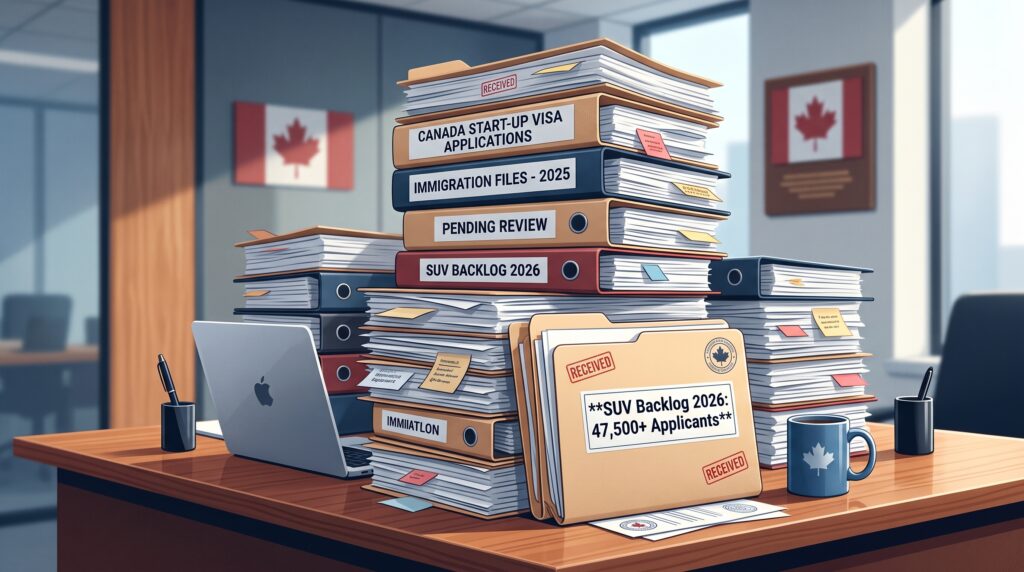
- The wait is very long. About 47,500 people are in line. Canada plans to admit 500 per year in this category.
- Some files move faster than others. It depends on who backed your startup and whether someone on your team has a start-up visa work permit.
- Never cancel your Startup PR application. If one key founder pulls out, everyone on the team gets refused.
- But winning another way is safe. If you get permanent residence through a different program, your co-founders do not get refused. IRCC pauses your file, checks theirs, and can approve them first.
Should You Just Wait for the Start-Up Visa Backlog to Clear?
For most people, no.
Here is the maths. About 47,500 people are waiting. Canada plans to let in 500 people a year in this category, and that 500 also covers a separate self-employed program. So, the real number of start-up visa spots is even smaller.
That does not mean you give up on your file. Keep it. It still protects your co-founders, and it may still come through one day. But you should not treat it as your only Plan A.
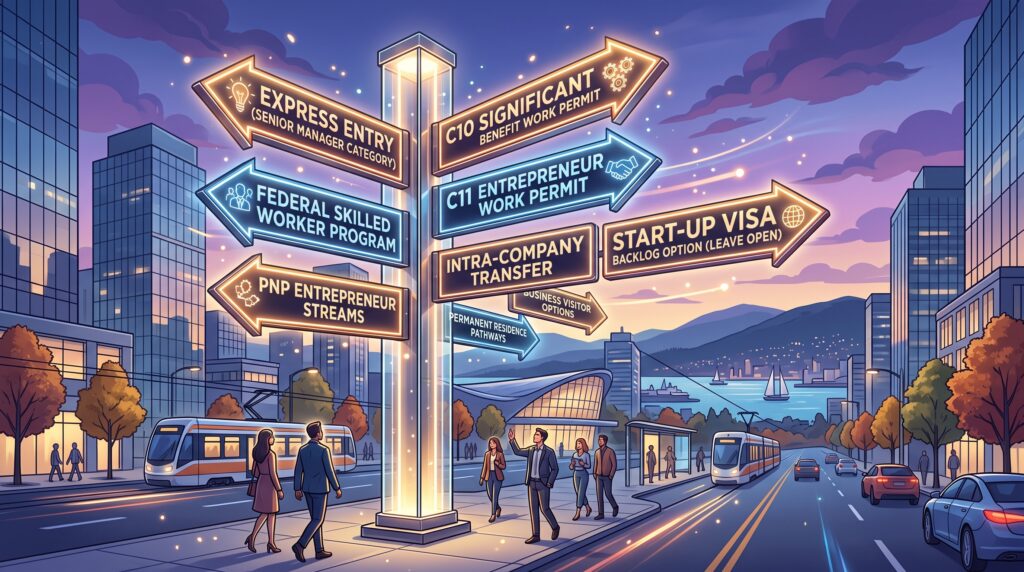
Instead, start a second application through a different program. Which one suits you depends mostly on one thing: are you in Canada right now, or waiting abroad?
This article walks through both. It also explains the one mistake that can end the process for your whole team — and the rule that makes a second application safe.
|
Words You Will See in This Article
Immigration paperwork is full of jargon. Here is what the main terms mean, in plain English.
| Term | What It Means |
|---|---|
| Commitment certificate | The letter your investor or incubator sent to IRCC promising to back your business. |
| Designated organization | A venture capital fund, angel investor group or business incubator that Canada has approved to back start-up visa founders. |
| Essential person | A founder the startup marked as key to the business. If they drop out, the whole team is affected. |
| Express Entry | Canada’s online system for skilled worker permanent residence. You enter a profile, get a score, and wait to be invited. |
| The pool | Everyone with an active Express Entry profile. You must be in the pool before you can be invited. |
| CRS score | Your points score in Express Entry. Based on age, education, language, and work experience. |
| ITA | An Invitation to Apply. You get one when your score is high enough in a draw. |
| NOC code | The official code for a job. Your duties, not your job title, decide which code you fall under. |
| PNP | Provincial Nominee Program. Each province can nominate people for permanent residence, including the entrepreneurs like you. |
| IRCC | Immigration, Refugees and Citizenship Canada — the department that decides your application. |

If You Are in Canada on a Start-Up Visa Work Permit
You are in the better position. But maybe not for the reason you have been told.
The Senior Managers Route
In 2026, Canada created a new Express Entry category for senior managers who have worked in Canada. For founders, this is the most promising option right now.
It covers four job codes:
| NOC Code | Title (NOC 2021) | TEER | Typical Roles |
|---|---|---|---|
| 00012 | Senior managers – financial, communications and other business services | 0 | CFO, VP Finance, Managing Director (banking, telecom, professional services) |
| 00013 | Senior managers – health, education, social and community services and membership organizations | 0 | Hospital CEO, university president, executive director (NGO) |
| 00014 | Senior managers – trade, broadcasting and other services | 0 | Retail chain president, broadcasting general manager, hospitality VP |
| 00015 | Senior managers – construction, transportation, production and utilities | 0 | Construction company president, logistics VP, utility executive |
You need 12 months of full-time work in Canada in one of these roles, within the last three years. Part-time counts if it adds up. Work you did outside Canada does not count for this category.
Three draws have been held so far, and the score you need keeps dropping:
| Draw Number | Draw Date | Category | ITAs Issued | Minimum CRS Score | Tie-Breaker |
|---|---|---|---|---|---|
| 444 | September 16, 2026 | Senior Managers (NOC 00) | 250 | 389 | September 01, 2026 at 23:05:13 UTC |
| 426 | July 10, 2026 | Senior Managers (NOC 00) | 500 | 392 | March 15, 2026 at 01:46:05 UTC |
| 402 | March 5, 2026 | Senior Managers (NOC 00) | 250 | 429 | August 19, 2025 at 15:10:18 UTC |
That is 1,000 invitations in three draws. The score needed fell from 429 to 389. Compared with the general draws, that is a low bar. This is the strongest reason to take this route seriously.
The Step Most Founders Miss
Here is the catch, and it matters.
These draws do not let you in on their own. They pick people who are already in the Express Entry pool. To get into the pool, you must first qualify under one of three programs.
So, the real question is not whether you look like a senior manager. It is how you get into the pool at all.
One of those three programs is the Canadian Experience Class. For most founders, that door is shut. The rules say work you did for your own company does not count. IRCC tells its officers that this program needs experience gained “through authorized employment by a third party” — meaning you worked for someone else.
Paying yourself a salary from your own company does not change this. The same guidance says people “who hold substantial ownership and/or exercise management control of a business for which they are also employed are generally considered to be self-employed.” Officers look at how much control you have, whether you carry the financial risk, and whether you could hand the work to someone else. Canadian courts have taken the same view.
|
So, what does work? Get into the pool through the Federal Skilled Worker Program instead. It uses your work experience from before you came to Canada, plus your language scores and education. The self-employment rule does not apply there. Once you are in the pool, the senior managers draws can pick you up based on your Canadian role. This combination is what makes the route realistic for business owners. |
Does Your Job Really Count as Senior Manager?
This is where founders get into trouble. The honest answer: owning the company is not enough.
What matters is what you actually do all day. Officers look for:
- You set the strategy and long-term goals.
- You manage other managers — not just regular staff.
- You control budgets, hiring and how resources are shared out.
- You make the big decisions about where the business goes.
If you run a small business and do most of the work yourself, this will not fit. Your title does not matter. Your reference letters have to show real executive responsibility.
The good news is how IRCC picks people. IRCC chooses on your job code and your score — not on whether you are an employee or the owner. If your daily role genuinely fits, and you run the business through other managers, this route can be open to you.
| Please take this warning seriously
Be honest about your job code. If your real day-to-day role fits a senior manager code, it will hold up. If it does not, you risk refusal — and in bad cases a finding of misrepresentation, which can block you from Canada for years. Get your job code checked properly before you file, not after IRCC questions it. |
We have followed this category since the government asked for public input in August 2025, and we sent IRCC formal recommendations on how it should be built. Our senior managers guide explains the evidence you need. Our Express Entry page for business owners shows how the programs fit together.
Provincial Programs
A provincial nomination is the most reliable way to make up for a low score. It takes you out of the general competition entirely.
If your role will not support a senior manager claim, a provincial entrepreneur program is the better second route. But it works differently from the start-up visa, and the difference is important.
The start-up visa was based mostly on your plan. You proposed a business and promised to run it. Provincial programs are based on results. You sign an agreement with targets, you run the business, and only then do you get nominated.
British Columbia’s Base Stream is a good example:
| What You Need | How Much in CAD |
|---|---|
| Personal net worth | At least $600,000 |
| Money invested in the business | At least $200,000 |
| Jobs created | At least 1 full-time job for a Canadian |
| Then | Sign the agreement, get a support letter |
| Apply for your work permit | Within 90 days |
| Arrive in B.C. | Within 12 months |
| Time until nomination | About 18 to 20 months of running the business |
Provincial rules are changing fast. Ontario closed all nine of its programs in 2026 while it builds new ones. Rules about applying to a province while you have a federal application open differ from province to province, and they change. Check with the province before you file.
| Our provincial programs guide covers each province, and our British Columbia page goes into more detail. |
If You Are Waiting Outside Canada
Without status in Canada, you are stuck behind the 500-person limit. Your first goal is to get here legally. That opens up everything else.
Keep the Business Genuinely Alive
The rules say you must actively run the business from inside Canada. If you are abroad and cannot do that yet, the officer has to believe you truly intend to do it once you get permanent residence.
That is an easier test. But it is still a test of whether you are believable. A company that has done nothing for two years fails it.
So keep records. Contracts, meeting notes, accounts, product work. Anything showing the business is real and moving.
The C10 Work Permit
A C10 permit is for people whose work brings a clear benefit to Canada. It sits completely outside the start-up visa queue.
IRCC rewrote its guidance on this in February 2026, giving officers clearer direction. What it means for you: vague claims no longer work. You need to say exactly what the benefit is and prove it. Name your customers. Show signed contracts. Say how many jobs, and where.
For current processing times, check IRCC’s official tool. Do not trust numbers quoted in articles, including ours — they change.
The C11 Work Permit
C11 is for business owners. The rules got much tighter in 2025:
- You must own at least 51%. Equal partnerships no longer qualify.
- Two separate pots of money. Business funds and personal living money must be kept apart. You need 18 months of living costs set aside.
- A plan for leaving. Officers want to see how the business carries on without you.
- Permits now run 18 months, up from 12.
One thing to plan for. C11 work runs into the same self-employment problem described above. So, your bridge to permanent residence is a provincial nomination, or the senior managers route through the Federal Skilled Worker Program — not the Canadian Experience Class.
See our guide to the 2025 C11 changes and our C11 page.
What Happens to Your Co-Founders If You Get In Another Way?
This is the question that decides whether a second application is safe. The answer is better than most founders expect.
IRCC treats two situations very differently.
Situation 1: A key founder quits or is refused
| IRCC’s instructions to officers say that “all applications linked to the same business proposal must be refused for not meeting the requirements to be a member of the start-up business class.” |
In plain terms: if one key founder walks away, everyone else on the team gets refused. Even the ones who did everything right.
So never cancel your application to make room for another one.
Situation 2: A key founder gets permanent residence another way
Here the rule is completely different. This is the part that makes a second application safe. From IRCC’s instructions:
| “When an essential member has obtained permanent residence from another program, place their SUV application on hold pending assessment of the rest of the group.”
“If all other requirements are met, officers can approve the rest of the group before proceeding with the administrative withdrawal of the applicant who has obtained permanent residence.” |
In plain terms: if you get permanent residence through another program, IRCC does not punish your team. The officer pauses your file, looks at everyone else’s, and can approve them first. Only then does IRCC close your start-up visa file for you.
The difference is between walking away and moving on. Quitting the business sinks the group. Winning permanent residence somewhere else does not.
The same protection applies if a key founder dies. And there is one more safeguard: if a key founder’s application is missing, officers are told to check whether that person already got permanent residence another way before warning the rest of the team.
| What to actually do
• Talk to an experienced senior immigration lawyer for 1 hour. • Start your second application and leave the start-up visa file open. • Never cancel it yourself. Do not let a co-founder cancel without advice. • When your other application is approved, let IRCC close the file. Do not do it yourself. • Tell your co-founders what you are doing. They should not find out from a letter. |
What Bill C-12 Means for Your File
A new law came into force in March 2026. It lets the government pause, suspend or cancel whole groups of immigration applications at once.
We want to be calm about this, because it has been reported in frightening terms.
The powers are real, and a paused queue like the start-up visa backlog could be affected. But there are limits. The government cannot use these powers to take away someone’s status. It must give a reason — fraud, public health or safety, an administrative error, or national security. Every decision has to go through Cabinet, be published officially, and be reported to Parliament.
Our view: this is a reason to get moving on a second application. It is not a reason to panic about the one you have. A file sitting in a backlog is more exposed than one being actively worked on. We explain more in our note on Bill C-12 and the Start-Up Visa.
Common Questions
Can I apply to a province while my start-up visa application is still open?
In several provinces, yes. This is the main way around the 500-person limit. But rules differ by province and have changed through 2026, so check with the province first. What you must not do is cancel your start-up visa file to make room.
If I get permanent residence another way, will my team be refused?
No. IRCC tells its officers to pause your start-up visa file, check everyone else on the team, and approve them if they qualify. Only then does IRCC close your file. This is exactly why a second application is safe and cancelling is not.
Can I use the senior managers route as a founder?
Often yes, and it is the best option available in 2026. You need 12 months of senior management work in Canada in one of four job codes. The catch is that these draws only pick people already in the Express Entry pool. If you own and control your company, you probably cannot get into the pool through the Canadian Experience Class, so the Federal Skilled Worker Program is usually the way in.
Will my application move into the new entrepreneur program?
There is no promise that it will. The government has hinted the new program may favour people already in Canada on a work permit, but nothing has been published as of September 2026. Plan as though your file will not transfer.
How long is the wait, really?
With about 46,000 people in line and 500 spots a year, files near the back face a wait measured in decades unless the policy changes. Files in Group 1 with early dates are in a very different position. Check IRCC’s processing times tool for official figures.
My co-founder wants to give up and go home. What happens to me?
This is urgent. If they are a key founder on the certificate and they cancel, IRCC must refuse every application tied to that business — including yours. Get legal advice before they do anything, not after.
Final Thoughts
The Start-Up Visa worked well for ten years. Then far more people applied than Canada had room for — roughly ninety applicants for every spot. That is not a reflection on your business. It is arithmetic.
Here is what we tell clients in your position.
Keep the start-up visa file open, and keep the business genuinely active. The file still protects your co-founders, and it is still a real path, even if a slow one.
Then build a second route that does not depend on those 500 spots. The senior managers category if you can get into the pool. A provincial program. Or a work permit to get you into Canada first.
And take comfort in this: IRCC’s own rules make that second route safe. Getting in another way pauses your file. It does not sink your team.
The founders who do well over the next two years will be the ones who stopped treating the Start-Up Visa as the plan, and started treating it as one option among several.
| Where do you actually stand?
Every file is different. Your group, your dates, your team and where you live all change what is open to you. We have guided entrepreneurs from more than a dozen countries through these exact decisions. Book a 1-hour strategy meeting and we will read your paperwork, tell you which group your file is in, and map out the routes that fit you. |
Where These Rules Come From
For readers who want the legal references behind this article:
| Point | Source |
| Self-employment does not count for the Canadian Experience Class | IRPR R87.1(3)(b); IRCC instructions on CEC qualifying work experience |
| You must actively run the business from inside Canada | IRPR R98.01(2)(d) and R98.06(1) |
| If a key founder quits or is refused, the group is refused | IRCC instructions on withdrawal or refusal of an essential person |
| If a key founder gets PR another way, the group is assessed first | IRCC instructions on assessing the application (start-up business class) |
| Priority groups and the lock-in date | Ministerial Instructions of December 20, 2025; IRCC instructions on assessing the application |
| C10 significant benefit work permits | IRPR R205(a); IRCC guidance updated February 24, 2026 |
| 500 admissions a year in Federal Business | 2026-2028 Immigration Levels Plan (supplementary information) |
About the Author
Rakhmad Sobirov is the Founder and Managing Lawyer of Sobirovs Law Firm, a boutique Canadian business immigration practice recognized by Chambers & Partners and The Legal 500. He holds a Juris Doctor from the University of Ottawa Faculty of Law and is a member of the Law Society of Ontario (LSO No. 62387E), the Canadian Bar Association and the Toronto Lawyers’ Association. He has worked with international entrepreneurs and companies across six continents for over 13 years. Read his full profile.
How we checked this: every detail here was verified against IRCC and provincial government sources in September 2026. We review this article every six months.
| This article gives general information about Canadian immigration law. It is not legal advice. The rules change often, and how they apply depends on your own situation. No result is guaranteed. For advice on your case, speak to a licensed Canadian immigration lawyer. |

Canada Start-Up Visa Backlog 2026: What Your Options Are Now
Key Takeaways: The Start-Up Visa is closed. No new applications. The last day to apply was June 30, 2026. The wait is very long. About...Our Clients Say…
 (189 reviews)