
Moving an existing company to Canada is one of the most direct routes for a foreign business owner to establish Canadian operations and obtain a work permit. The primary vehicle is the Intra-Company Transfer (ICT) work permit — an LMIA-exempt permit under section R205(a) of the Immigration and Refugee Protection Regulations (IRPR) that allows foreign companies to transfer executives, senior managers, and specialized knowledge employees to a qualifying Canadian entity. This guide walks you through the four steps to assess eligibility, incorporate in Canada, prepare your application, and build your operations once you arrive.

Please Note
Canadian immigration is always changing. Therefore, before proceeding with any immigration project, please consult with our lawyers.
Step-by-Step Guide: How to Expand Your Business to Canada via the ICT Work Permit
If you want to set up your company’s operations in Canada and obtain a Canadian work permit for yourself or your team members, you should consider applying for the Intra-Company Transfer (ICT) program. The ICT program allows foreign companies to expand to Canada and transfer their staff members (executive, managerial or specialized knowledge employees) to work in Canada. To be eligible for this program, both the expanding company and the applicant must meet a number of requirements, as discussed below. Depending on your country of nationality and other factors, getting a work permit may take approximately 2–4 months — check the current estimated processing time on the IRCC processing times tool before planning your timeline.
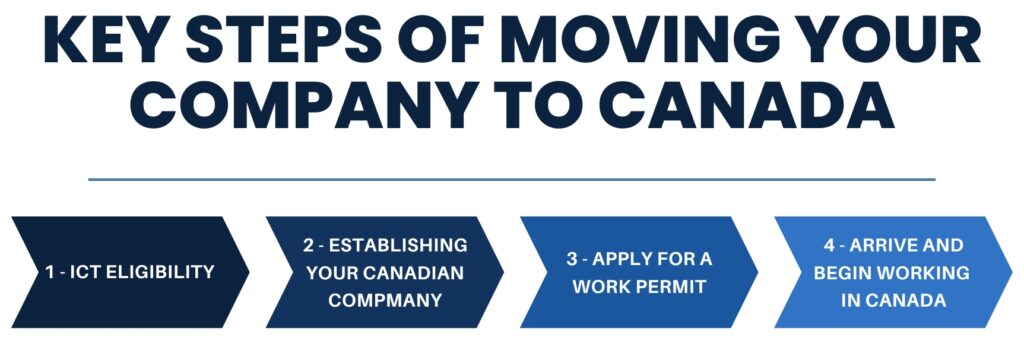
Below are the steps to follow in order to expand your business to Canada.
Step 1: Check if your company is eligible to expand to Canada under the Intra-Company Transfer Work Permit Program
Not all business owners can move their companies to Canada. To benefit from the ICT program’s provisions, both the expanding companies and the chosen applicants must meet multiple requirements.
Requirements for Foreign Companies:
-
Active engagement in business in two countries
Your home company must be fully operational and currently doing business (selling services or goods, having employees, customers and revenue) in your home country and at least one more country other than Canada. There’s an exception to this requirement for companies from free trade agreement countries. See our Comprehensive Guide on Canada’s New Intra-Company Transfer Work Requirements for more details.
-
History of operations
Your company must be at least 1 year old. The older the company, the more support it can lend to your application.
-
Sufficient gross revenue
Your business should be able to demonstrate sufficient gross revenue to support a Canadian expansion — as a general benchmark, Sobirovs lawyers typically see officers look for CAD $300,000 or more in annual sales, though this is not a statutory minimum. Companies below this threshold should discuss their specific circumstances with a Canadian immigration lawyer before applying.
-
Availability of liquid funds to expand
As a practical guide, Sobirovs recommends having at least CAD $100,000 in accessible funds to cover your first year of Canadian operations — including incorporation costs, office lease, salaries, and operating expenses. This is not a statutory requirement, but officers assessing the viability of your expansion will scrutinize your funding closely.
-
The rationale for expansion
Your company should have good business reasons to expand to Canada. For example, better-serving customers in North America or engaging in export activities from Canada are usually considered good reasons to expand. There may be other good reasons to expand, so make sure to discuss this aspect with your immigration lawyer.
Requirements for Applicants:
-
Position in your home country
You must hold an executive, senior manager, or specialized knowledge worker position in your current company.
-
Length of employment
You must have been employed full-time by the foreign company for a continuous period of at least one year within the three years immediately preceding the date of your work permit application. This employment must have been in a role similar to the position you are being transferred to in Canada — executive, senior manager, or specialized knowledge worker.
-
Position in Canada
You must demonstrate that you are being transferred to a similar position in Canada.
If you think your company meets the eligibility criteria for the ICT program, you can proceed to the next step, which is registering your company’s presence in Canada.
Step 2: Establish your company in Canada
When establishing your presence in Canada, it is important to pay attention to the corporate ownership structure of your Canadian company. The law requires that your existing business in your home country and your company in Canada must have a parent/subsidiary or an affiliate relationship. In other words, your Canadian company must be registered as a parent, subsidiary or affiliate company of your existing business.
A subsidiary relationship between two companies exists when your foreign company owns and controls your Canadian company. Parent relationship is established when your Canadian company owns and controls your home company. An affiliate relationship is established when the same individuals (or group of individuals) who own and control your home company also own and control your company in Canada.
Once you are clear about your Canadian company’s ownership structure, you need to decide where to base your first corporate office in Canada. If you incorporate federally under the Canada Business Corporations Act (CBCA), you are required to have at least 25% of your directors be Canadian residents (or at least 1 director if you have fewer than 4). However, provinces vary significantly: Ontario and British Columbia have eliminated the Canadian residency requirement for directors, making them popular incorporation choices for foreign entrepreneurs. Always confirm current provincial requirements with a Canadian corporate lawyer before incorporating.
If you don’t have someone who can act as your Canadian Director, you should get your Canadian law firm’s guidance on this issue or talk to an accounting firm in Canada who can assist you with this matter.
Step 3: Apply for ICT Work Permit
Once your company is registered in Canada, you can apply for a work permit to work at your newly established Canadian company. The ICT work permit is LMIA-exempt under Immigration and Refugee Protection Regulations (R205) — your Canadian company does not need to complete a labour market test before you submit your application. In order to apply for a work permit, you must collect and present Canadian immigration officers a number of documents to demonstrate your eligibility under the ICT program.
Make sure to include the following documents:
-
Foreign Company Documents
Company registration documents clearly showing the date of establishment (the company must be at least 1 year old), ownership documents, and proof of engagement in business (website, marketing materials, tax filings, licenses/permits, commercial lease agreement, employee remittance payments, etc.).
-
Applicant’s Employment History with the Company
Employment contract, employment records & payslips, personal tax filings with employment information on it, proof of remuneration or dividend payments (for business owners), company’s org chart, business cards, reference letters, etc.
-
Financial Documents
Company’s tax reports with information on gross revenues and sales reports; corporate bank statements showing sufficient liquid funds to expand.
-
Canadian company documents
Registration documents (Articles of Incorporation), licenses & permits (if any); shareholder agreement or share certificate confirming ownership of the company; lease agreement (if any); financial documents (if any) and marketing material (website and other promotional material, if any). If this is your first ICT transfer, include a Business Plan that clearly explains the rationale for expansion, proposed business activity, investment amount, cash flow projections and hiring plan.
-
Transfer Letter
Include a letter from the home company explaining the applicant’s current role in the company (executive, managerial or specialized knowledge worker), the position they will be taking in Canada, and why their presence in Canada is required.
-
Applicant’s Personal Documents
You should also include personal documents of the applicant, such as a Resume, educational credentials, certificates & licenses, reference letters, and any evidence of the applicant’s advanced education or expertise. You should also include evidence which demonstrates ties to the home country (like assets, resident family members, etc.), their travel history, police clearances, medical examination results and other important documents.

ICT work permit validity depends on your Canadian entity’s operating history. Newly established companies (less than 12 months of operations) typically receive a 1-year initial permit. Established companies can receive permits of up to 3 years. Both are renewable, provided your business continues to meet ICT program requirements at the time of renewal.
Your spouse or common-law partner can apply for an open work permit, allowing them to work for any Canadian employer while you hold a valid ICT work permit. Dependent children can apply for a study permit or visitor record. Children’s age eligibility depends on their dependency status under IRPR.
Step 4: Arrive and Begin Working in Canada
Processing times for ICT work permit applications vary depending on your country of citizenship, the visa office processing your file, and IRCC’s current volumes. Check the current estimated processing time on the IRCC processing times tool before planning your timeline. Once your work permit application is approved, you will be issued a work visa to travel to Canada (depending on your citizenship). The work permit document will be issued at the port of entry upon your arrival to Canada.
In order to extend your ICT work permit, you must demonstrate to the Canadian immigration authorities that you have successfully established your operations in Canada and have been actively doing business. Specifically, the officer will assess the following factors before extending your ICT work permit application:
-
Business in Canada
By the time you apply for an extension, you must be able to demonstrate that you have a genuine business in Canada and that your business is actively selling goods or services to customers in Canada or around the world. Note that you do not necessarily have to be a profitable business, but your business should be viable and generate enough revenue to cover the costs of your operations and pay your employees.
-
Physical Presence
Your company must have a physical presence in Canada and should not operate virtually from Canada. Although many businesses now operate virtually or remotely, your company is still required to secure commercial premises in Canada where you and your employees can work.
-
Employees in Canada
The officer will also assess if your company has employees working in Canada. Even if your employees work remotely in Canada, you must demonstrate that your business has at least 1 local employee by the time you apply for an extension.
-
Foreign Company
Your foreign company must continue to be actively engaged in doing business in your home country and have the same ownership structure as in your initial work permit application.
Keep in mind that the officer must be satisfied that your presence in Canada is still required when you apply for your ICT work permit extension. Therefore, you must demonstrate that your business is active and your leadership is essential for your team in Canada.
Frequently Asked Questions About Moving Your Company to Canada
The ICT work permit is an LMIA-exempt Canadian work permit under IRPR R205(a) that allows foreign companies to transfer executives, senior managers, and specialized knowledge employees to a qualifying Canadian affiliate, subsidiary, or parent company. It is one of the most efficient routes for an established foreign business to enter the Canadian market without going through the standard LMIA process.
Validity depends on how long your Canadian entity has been operating. Newly established companies typically receive a 1-year initial permit. Established companies can receive up to 3 years. Both are renewable provided your business continues to meet program requirements.
No. The ICT work permit is LMIA-exempt under IRPR R205(a). Your Canadian company does not need to complete a labour market test before you submit your work permit application.
Yes. Your spouse or common-law partner can apply for an open work permit. Dependent children can apply for a study permit or visitor record. See IRCC’s family member eligibility criteria for details.
ICT work permit holders can pursue permanent residence through Express Entry for Senior Managers — specifically the Canadian Experience Class after 1 year of Canadian work experience in a TEER 0, 1, 2, or 3 occupation, or the Express Entry Senior Managers category if you hold a NOC TEER 0 management role. Provincial Nominee Programs (PNP) offer additional pathways depending on your province of operations. The C11 Entrepreneur Work Permit is a related but distinct option for business owners who own and control their Canadian company.
If your company is new (less than 1 year old), you do not currently employ the transferee in a qualifying role, or the Canadian entity does not yet have the required corporate relationship, the ICT program may not be available to you. Alternative pathways include the C11 Entrepreneur Work Permit, the Start-Up Visa Program, or Provincial Nominee Program entrepreneur streams. Book a consultation with Sobirovs to assess which pathway fits your situation.
Sobirovs Law Firm Can Help
We hope that we’ve given you an understanding of the process of expanding your company from anywhere in the world to Canada using the ICT program. You can now decide whenever you are ready to take your company to the next level.
There have been many cases recorded in the past where people took this step of courage to expand their companies to Canada and have seen boosted profits. As with doing business anywhere, doing business in Canada has its challenges. Nonetheless, the advantages of expanding your business to Canada are far greater than the challenges themselves. We are here to help you overcome them!
For more information on moving your company to Canada, speak to our business immigration lawyer. The business immigration experts at Sobirovs Law Firm will not just help you move your existing company to Canada but will also help you choose the right type of business entity when moving your business to Canada.
Reasons to Bring Your Business to Canada
Canada is the world’s second-largest country by land area and the 10th-largest economy. Entering Canada offers many benefits, such as exploring new markets, taking advantage of the government’s incentives, and enjoying business-friendly laws and regulations.
An Ever-Growing Economy
With an ever-growing economy, Canada facilitates global business owners. Many such business owners and business immigrants wonder whether they can move their companies to Canada and face disproportionate fear and anxiety when considering the challenges that come with making such an immigration decision. The steps to moving your company to Canada are fairly straightforward. We will help break down the complexities and highlight the benefits of moving or expanding your company.
The following are some of the many reasons that entrepreneurs all over the world are choosing to benefit from the opportunities that Canada has to offer them.
Comparatively Lower Costs of Expansion Than the United States
Canada consistently ranks among the lowest-cost G7 countries for business operations. KPMG’s Competitive Alternatives report identifies Canada as offering a measurable cost advantage over the United States across a range of business sectors — driven by lower labour costs, competitive tax rates, and federal and provincial incentive programs. For current cost comparisons, see Invest in Canada’s resources at investcanada.ca.
Canada also boasts a number of business-focused policies and standards to help attract thriving businesses and innovative entrepreneurs. They include:
Low Corporate Taxes
Canada’s federal corporate income tax rate is 15% for general corporations. Combined with provincial rates, the effective rate typically ranges from 23% to 31% — competitive by G7 standards and meaningfully lower than the equivalent combined U.S. federal-state rate. Canadian-Controlled Private Corporations (CCPCs) earning active business income up to $500,000 may qualify for the small business deduction, reducing the federal rate to 9%.
Access to the US and Mexico Markets through CUSMA (formerly NAFTA)
Canada enjoys the benefits of having trade agreements with many other countries. Due to the Canada-United States-Mexico Agreement (CUSMA), Canada has access to the US and Mexico markets, providing exponential benefits to new and growing companies choosing Canada as their home.
Friendly Immigration Policies
Canada maintains one of the highest per-capita immigration rates among developed nations, with a strong preference for economic-class immigrants — skilled workers, business owners, and investors who contribute to the Canadian economy. Federal permanent resident targets are set annually; the current 2026–2028 plan focuses on economic-class admissions while moderating overall volumes to address housing and infrastructure priorities.
Highly Skilled Workforce
Canada has historically been the destination for high-skilled workforce migrants. Access to a highly skilled workforce is one of Canadian companies’ main competitive advantages.
Ease of Doing Business
Canada is consistently recognized as one of the most business-friendly countries in the G7. The OECD highlights Canada’s regulatory environment, straightforward business incorporation process, and access to financing as competitive advantages. For entrepreneurs, this means a predictable legal framework and a straightforward path to setting up and running a company.
Canada’s natural resources — including oil, natural gas, mining, and forestry — contribute significantly to GDP and provide a stable economic base. The energy sector supports hundreds of thousands of jobs and generates substantial federal and provincial government revenue, underpinning the fiscal stability that makes Canada an attractive destination for international business investment.
Fundamental human rights and additional freedoms are guaranteed in Canada. Business immigrants can benefit from free health care and free secondary education for their children if they opt for Canada for their company’s international expansion.
About the author

Rakhmad Sobirov is a Canadian immigration lawyer licensed to practice law in Ontario, Canada, since 2011. He holds a Juris Doctor from the University of Ottawa Faculty of Law (2011), a Master of Laws from Central European University in Budapest (2004), and a Master of Arts in Political Science from the OSCE Academy in Bishkek (2005). A member of the Law Society of Ontario, the Canadian Bar Association, and the Toronto Lawyers Association, he has published in SHRM, The Lawyer’s Daily, and Tech Talent Canada.